
Counseling Specialty
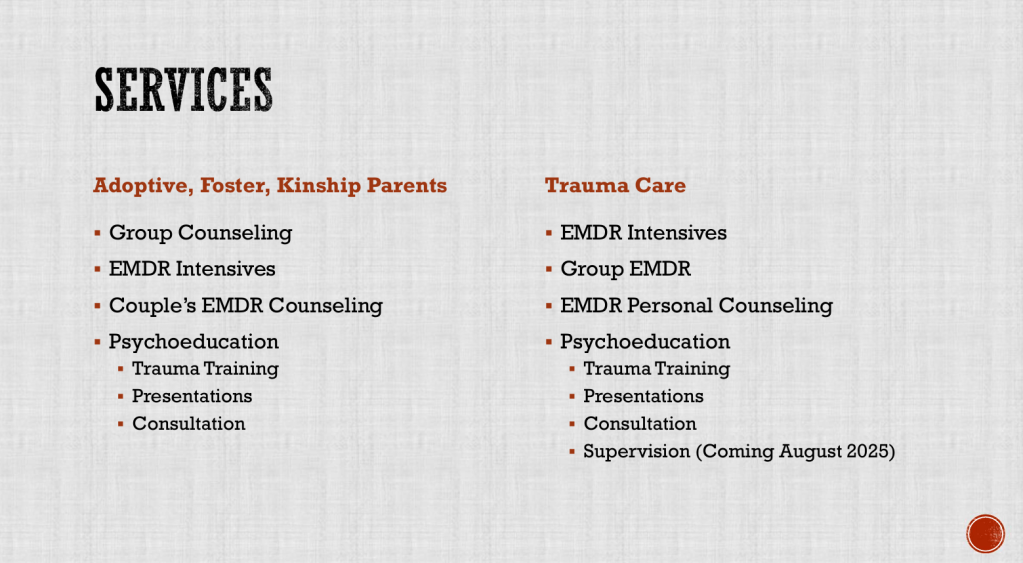
Erica is a Licensed Professional Counselor and adoptive mom with over 10 years of experience in the adoption community. She is passionate about helping adoptive parents make sense of their children’s difficult behaviors. She has studied trauma, attachment, interpersonal neurobiology, and has training in EMDR. She desires to help other parents who feel that their lives have been challenged by the trauma of their adopted children. She also hopes to help parents understand the developmental and emotional impact of trauma on children and provide tools to help them navigate parenting in unchartered waters and heal from the wounds of parenting in what often seems a battleground.
Counseling CACREP Doctoral Competencies (2016):
a. Scholarly examination of theories relevant to counseling
b. Integration of theories relevant to counseling
c. Conceptualization of clients from multiple theoretical perspectives
d. Evidence-based counseling practices
e. Methods for evaluating counseling effectiveness
f. Ethical and culturally relevant counseling in multiple settings
Supporting Artifacts
Created during COUC 715 Advanced Theory Application
- Students examine existing and emerging theories of counseling to increase their understanding of ethical and effective assessment and intervention within the therapeutic environment. The student will be able to critically analyze, evaluate, and synthesize a broad range of counseling theories, with an advanced understanding of psychopathology, to inform case conceptualization and deliver and evaluate evidence-based interventions across diverse populations and settings (CACREP Standard: 6.B.1 Counseling). Students will also explore the relation of these competencies to counselor education (CACREP Standards: 6.B.3 Teaching), research and scholarship (CACREP Standards: 6.B.4 Research and Scholarship), and leadership and advocacy (CACREP Standards: 6.B.5 Leadership and Advocacy).
To demonstrate competency in counseling, artifact 43 shows the (a.) scholarly examination of theories relevant to counseling along with (b.) integration of theories relevant to counseling within the Capstone Project for COUC 710. This artifact (43) also covers (c.) conceptualization of clients from multiple theoretical perspectives, (d.) evidence-based counseling practices, (e. ) methods for evaluating counseling effectiveness, and (f.) ethical and culturally relevant counseling in multiple settings by delving into a client case, conceptualizing to apply evidence-based practices, and evaluating those practice within an ethically and culturally relevant manor.
Additionally, mastery of (a.) scholarly examination of theories relevant to counseling, (b.) integration of theories relevant to counseling, (c.) conceptualization of clients from multiple theoretical perspectives, (d.) evidence-based counseling practices, (e. ) methods for evaluating counseling effectiveness, and (f.) ethical and culturally relevant counseling in multiple settings is demonstrated in artifact 44 through an examination and synthesis of the DSM-5 requiring each of these criteria to be applied to current diagnostic methods.
Next, to examine the individual criteria of the CACREP counseling guidelines, artifact 45 describes the importance of each criteria along with specific application in my work to demonstrate mastery of each criteria (a. through f.).
Finally, a specific application of (a.) scholarly examination of theories relevant to counseling, (b.) integration of theories relevant to counseling, (d.) evidence-based counseling practices, (e.) methods for evaluating counseling effectiveness, and (f.) ethical and culturally relevant counseling in multiple settings is demonstrated in a presentation on Internal Family Systems shown in artifact 46. This presentation examined the theory of IFS to describe how it can be integrated into counseling and evaluated as an evidence-based, effective counseling practice within an ethically and culturally relevant setting.
Created during COUC 710 Advanced Group Counseling
- This course is designed to provide further education and experience in the following core areas related to group counseling: applied theory, applied ethics, group process & dynamics, group techniques, application of group work with ethnic populations, and current research. This course includes an experiential portion in which students further develop their group leadership skills.
As such, artifact 47 displays comepetency in each area beginning with the (a.) scholarly examination of theories relevant to counseling as theory is examined and then (b.) integration of theories relevant to counseling by putting this examined theory into practice by (c.) conceptualization of clients from multiple theoretical perspectives to use (d.) evidence-based counseling practices in running a group with a co-leader. Then, after the group experience, using (e.) methods for evaluating counseling effectiveness to determine the benefits of the group experience while providing this experience with (f.) ethical and culturally relevant counseling in multiple settings (ie. the group experience).
Within Group Counseling, artifact 48 describes counseling proficiency of using (d. ) evidence-based counseling practices within the group setting, (e.) methods for evaluating counseling effectiveness as evidenced in the reflection of personal skills and the group experience, and finally, (f.) ethical and culturally relevant counseling in multiple settings as applied to the group setting.
Created during COUC 730 Issues in Integration
- Students critically explore issues related to ethical and effective integration of faith and spirituality in counseling, counselor education, supervision, research and scholarship, and leadership and advocacy. Special attention is given to the personhood and professionalism of the counselor/counselor educator when providing services in a multi-cultural society.
Artifacts supporting b. c. d. f.
As a Christian counselor, it is so important to integrate spiritual concepts in an (f.) ethical and culturally relevant [way through] counseling in multiple settings. Artifact 49 and artifact 50 address spiritual integration and Christian integration models that also demonstrate mastery in (b.) integration of theories relevant to counseling as theories from a Christian, spiritual lens are concidered along with (c.) conceptualization of clients from multiple theoretical perspectives. These artifacts also consider using (d.) evidence-based counseling practices within the Christian integration view of spirituality along with (e.) methods for evaluating counseling effectiveness as spiritual wholeness is part of biopsychosocial-spiritual health.
Created during COUC 850 Advanced Career Development and Counseling
- This course provides an extensive study of the current state of career development and of career counseling theory, research, and practice. Students examine the major theories of career development and vocational behavior, as well as their related constructs and interventions, including strategies for working with and advocating for diverse populations. In addition, students learn andragogy for effectively teaching career to master’s level students. Finally, students have the opportunity to examine the existing literature in order to learn how to advance the field through research, presentations, and leadership/advocacy in the field based on these readings. Students are required to already have a knowledge and understanding of basic career counseling theories at an entry-level competency.
To apply the CACREP criteria within the career counseling field, artifact 51 demonstrates mastery of each criteria within the (a.) scholarly examination of theories relevant to counseling, specifically, the Happenstance Theory of Career Development through (b.) integration of theories relevant to counseling within the career development specialty. This theory examination includes a (c.) conceptualization of clients from multiple theoretical perspectives while narrowing down to one specific theory that best fits particular situations and then uses (d.) evidence-based counseling practices to apply this theory. Additionally, consideration of (e.) methods for evaluating counseling effectiveness within an (f.) ethical and culturally relevant counseling in multiple settings are included.
To continue within this theory, artifact 52 and artifact 53 include a proposal and presentation on the Happenstance Learning Theory which also demonstrates mastery of (a.) scholarly examination of theories relevant to counseling, specifically, the Happenstance Learning Theory and how it can include (b.) integration of theories relevant to counseling within counseling career development for young adults. These artifacts include examination of (c.) conceptualization of clients from multiple theoretical perspectives while narrowing down to the population of young adults and then applying (d.) evidence-based counseling practices from this theory, along with (e.) methods for evaluating counseling effectiveness and considering (f.) ethical and culturally relevant counseling in multiple settings for the young adult population.
Counseling Experience
Clinical Mental Health Counselor June 2022 – Present
Emerge Counseling Ministries
Mechanicsburg, PA
Assess, develop, and review treatment plans monthly for an average of 20 clients ranging in age from 6 to 65 years of age. Provide adult, adolescent, child, marriage, and family counseling by implementing treatment plans using various therapeutic modalities including CBT, EMDR, IFS, and play therapy, among others as needed. Continuously document confidential client information according to HIPAA laws and ethical standards. Build rapport by creating felt-safety while maintaining professional boundaries. Participate in regular training, consultations, and staff meetings, collaborating with other staff as needed regarding client care.
Mobile Therapist August 2020 – February 2023
Laurel Creek Counseling
Lewisburg, PA
Provide mobile therapy for children, adolescents, and families in their homes or in the community following a prescribed treatment plan. Serve three to eight children weekly with two to four hours per week each of personalized therapy. Therapeutic care includes play therapy, CBT, client-centered therapy, and Parent-Child Relational Therapy (RCPT). Continuously document confidential client information according to HIPAA laws and ethical standards. Build rapport by creating felt-safety while maintaining professional boundaries. Participate in regular training, consultations, and staff meetings, collaborating with other staff as needed regarding client care.
Counselor January 2020 – Present
Richfield Life Ministries Church
Richfield, PA
Provide pre-marital, individual, and couples counseling for adults. Administer the SYMBIS assessment with pre-marital couples and discuss results, implications, and future directions. Assess all client’s needs, and utilize EMDR for clients with trauma histories, IFS, CBT, and client-centered counseling as needed. Continuously document confidential client information according to HIPPA laws and ethical standards. Build rapport by creating felt-safety while maintaining professional boundaries. Participate in regular training, consultations, and staff meetings, collaborating with other staff as needed regarding client care.
Mental Health Counselor August 2019 – August 2020
Diversified Treatment Alternatives Center
Lewisburg, PA
During practicum and internship, provided individual and group therapy for adolescent males in a residential facility following a prescribed treatment plan. Between 15 and 20 males were in residence and received play therapy, CBT, client-centered therapy, and group trauma therapy. Continuously documented confidential client information according to HIPAA laws and ethical standards. Built rapport by creating felt-safety while maintaining professional boundaries. Participated in regular training, consultations, and weekly staff meetings, collaborating with other staff as needed regarding client care.
Reflection of Counseling Competency
- Counseling has been a process of honing my life experiences into a way to make meaning and reflect back to others the meaning that I seen in their experiences through the help of the Holy Spirit. I see counseling as a sacred space and keep this in mind as I develop my skills and knowledge to put into practice allowing God to guide me and my words. When I finished my master’s program, I still felt so hungry for more knowledge and understanding to continue developing my abilities to help clients which led me into the doctoral program. Through this program, I have deepened my understanding of theories and strategies as well as the means to independantly grow as a professional. Being at Liberty and having the opportunity to integrate faith into my education is certainly the most meaningful to me both personally and professionally.
- I believe that one of my strengths in counseling that I have developed is seeking to discern what is the best theory to address the concerns of this particular client at this time. I believe it was Dr. Mwendwa who expressed this and I am most greatful for her input into my counseling and counselor educator identity. Having a greater understanding of the underlying issues and options for addressing those issues, takes away the cookie cutter practice and seeks to individualize the needs of each client. This is helpful both in my own counseling practice and as a way to stress to my future students that there is no “prescribed’ way of formulating treatment based on symptoms.
- Areas of growth include deepening my understanding of additional theories and methods to have a larger toolbox for helping clients. I also want to challenge myself to increase in my skills for marriage counseling, as that is an areain which I have less experience, but find that I am getting more clients requesting. I plan to get additional training in marriage therapy and review materials that I had studied in the past as well as consult with my collegues at my site.
- Once again, without my faith in Christ, I feel that this career field would be too overwhelming and I can certainly understand why there is so much burnout. Holding space for others and allowing them to share their burdens would be impossible for me to do if I were not able to take my clients to God’s throne and trust that He is the one who will do the work and use me as His instrument of healing.
Licensure and Certifications
Licensed Professional Counselor (February 2023)
National Certified Counselor June 2021
ADDITIONAL EXPERIENCE
Crisis Counselor September 1995 – November 1998
Colorado Springs Crisis Pregnancy Resource Center
Colorado Springs, CO
Interviewed clients on intake, assessed needs and advised of available resources. Provided a safe environment, listened to and reflected their concerns, and referred to medical or professional counseling as needed. Documented client encounters and maintained confidentiality.
 Erica Rhoads, PhD, LPC, NCC